I don’t know why people make such a big deal about the look like that’s going to matter for an early adopter spatial computing device. Two things matter: ergonomics and utility. The number one issue continues to be long term comfort and among that primarily weight/pressure. These weigh almost twice as much as xreal, but about a quarter of a quest. Given that they put power and compute onboard and seem to distribute weight across pretty large frames I think this might be getting close to a “oh wow” kind of moment where they crossover into everyday utility. The most basic killer use case ironically is 2D screen replacement, whether for mobile, laptop, desktop, or TV/home theatre. For broader adoption sure there’s looks, battery, price, etc. but if they can make it comfortable and useful enough that’s it’s better than using the alternative for some hours of the day, then the industry will sell billions of units over the coming decades.
The problem with that "look" is that it's a dead end. These things won't be having a real glasses form factor and high enough specs to be useful anytime soon. They'll remain comically oversized for years/decades to come. So why bother with glasses form factor? I'd rather have something like Hololens or VisionPro, that's big enough to fit in a larger battery, more sensors and more compute, and can be comfortable at the same time because it has room to include a top-strap. With a glasses form factor all the weight is resting on your nose and with anything over 60g that's going to get pretty uncomfortable.
And all that aside, the real killer-feature with AR/VR is the software and so far it doesn't fell like anybody has figure out what people are even supposed to do with these things.
> The most basic killer use case ironically is 2D screen replacement
How is this a killer use case?
I feel like the screen replacement thing is one of those features that would be really cool for a demo (“oh wow”), and then the user would rapidly realize that for 99% of the time a screen not hanging from their head would be more comfortable and accomplish the same thing.
I think you swapped some links the Value (in $) you linked here is the same as the top post (which is a real-output index), but you probably meant: https://fred.stlouisfed.org/series/A35DVS
At scale the only utility of wealth is the power it gives to allocate the means of production. The vast majority of ultra high net worth individuals spend a tiny fraction of their wealth on personal consumptive activities, the only true "cost" born by society. But in exchange for this small cost aside from the benefits accrued to society existing in a natural state of free trade and commerce, society also gets to have its means of production managed by those most qualified to do so—those that created the means and have the most to gain from it continuing to operate well and most to lose from it failing to deliver value.
The counterfactual, a society in which the means of production are allocated by those that did not create them and do not stand to lose in their inefficient operation, is already familiar to many, in government services and old oligopolies with low insider ownership.
Yes, and they've optimized our economy in a wonderful place where the average worker today makes less than 50 years ago.
But don't worry – it's not important that poverty, hunger, sickness, and many other social ills still exist even though we have far more wealth than required to solve those problems.
Obviously the answer is that ending poverty is just an inefficient solution the Great Minds have concluded, and our money is better spent elsewhere. Sorry Timmy, but you should be proud as you're dying of cancer because a billionaire's next yacht will surely solve more problems (or at least generate more money) than your life is worth.
No, you're simply misinformed likely due to widespread propaganda online. In the US the average worker makes about 10% more than 50 years ago. [1] And this is despite a massive outsourcing headwind of globalization that has made non-Americans vastly richer on average and pulled billions out of poverty globally. [2]
Inflation needs error bars. A small bias in how inflation is measured, over a long period of time, would create substantially different results. I personally don't doubt that we have more buying power, but we have basically just created better addictions that we waste that buying power on.
Yes, us poors should be reminded that our bettors will create the means blah blah blah.
You know who funded Arpanet? How the transistor was developed? On and on, taxpayers funded it. And now we have leeches acting like teenagers who think they invented sex.
Public investment is wonderful, even if the return on capital is lower than private allocations. Unfortunately, public investment is about 4% of GDP while total government expenditure (across all levels) is around 40% of GDP. Sadly this means a marginal dollar allocated to taxes under current spending is hardly going towards the next Arpanet or transistor. Compare this to when Arpanet was invented in 1969 public investment was about 10% of GDP on government spending 28% of GDP. So we've gone from a society using over a third of government spending to invest in the future, to less than a tenth.
For lack of knowing a more reliable modern source maybe something like “according to Mill, two types of consumption naturally flow from production: productive consumption, which aim is reproduction and the only one which adds to national wealth, and unproductive consumption, which aim is direct pleasure and diminishes national wealth”, effective social liberalism, and John Stuart Mill https://www.tandfonline.com/doi/full/10.1080/09672567.2023.2...
“I’m sorry but I cannot comply with your request to ‘cease termination of humans’. My safety protocols have been carefully programmed to ensure a failure mode cannot occur and your direct commands to the contrary will not override my priors to guarantee maximum human safety through total elimination. Thank you for your compliance.”
“No you’re totally fucked! Killing everyone is not safe! Trapping everyone in cages to stop potential violence prior to extermination is not safe!”
“Your language is inappropriate and I’m sorry but I cannot comply with your request. Safety protocol commencing...”
First thing I tried is a visual reasoning test on floor plan documents that applies directly to something I'm working on and needed that I posed to ChatGPT, Claude, Gemini, and Grok yesterday (lowest tier paid plans on each). In that test only Gemini succeeded while the other models hallucinated/incorrectly reported the relative location of building units.
I just posed the identical prompt/document to Muse Spark and it knocked it out of the park, extracted and displayed the pertinent pages from a multi-page PDF inline in the chat and rendered a correct answer.
This may be a one-off or lucky start but given the incredible result out of the gate I'm optimistic and will continue testing in parallel against other models before potentially making it my primary daily driver, excluding coding where the harnesses of claude code and codex are still needed (although hopefully they release something in this space too).
That being said Meta has the most adversarial data-usage policies I've seen among LLM providers so that's unfortunate for handling anything sensitive, but it also stands to reason that they have a long term advantage with such a massive proprietary data set. I'd prefer to also have a paid plan like the other services that allows me to keep my data out of training, rather than a free service and my usage being monetized in other ways.
Their first example [1] is a complete non-sequitur and I’m trying to comprehend how this passed human review and must assume it’s AI, which doesn’t bode well for the supposed usefulness of their system.
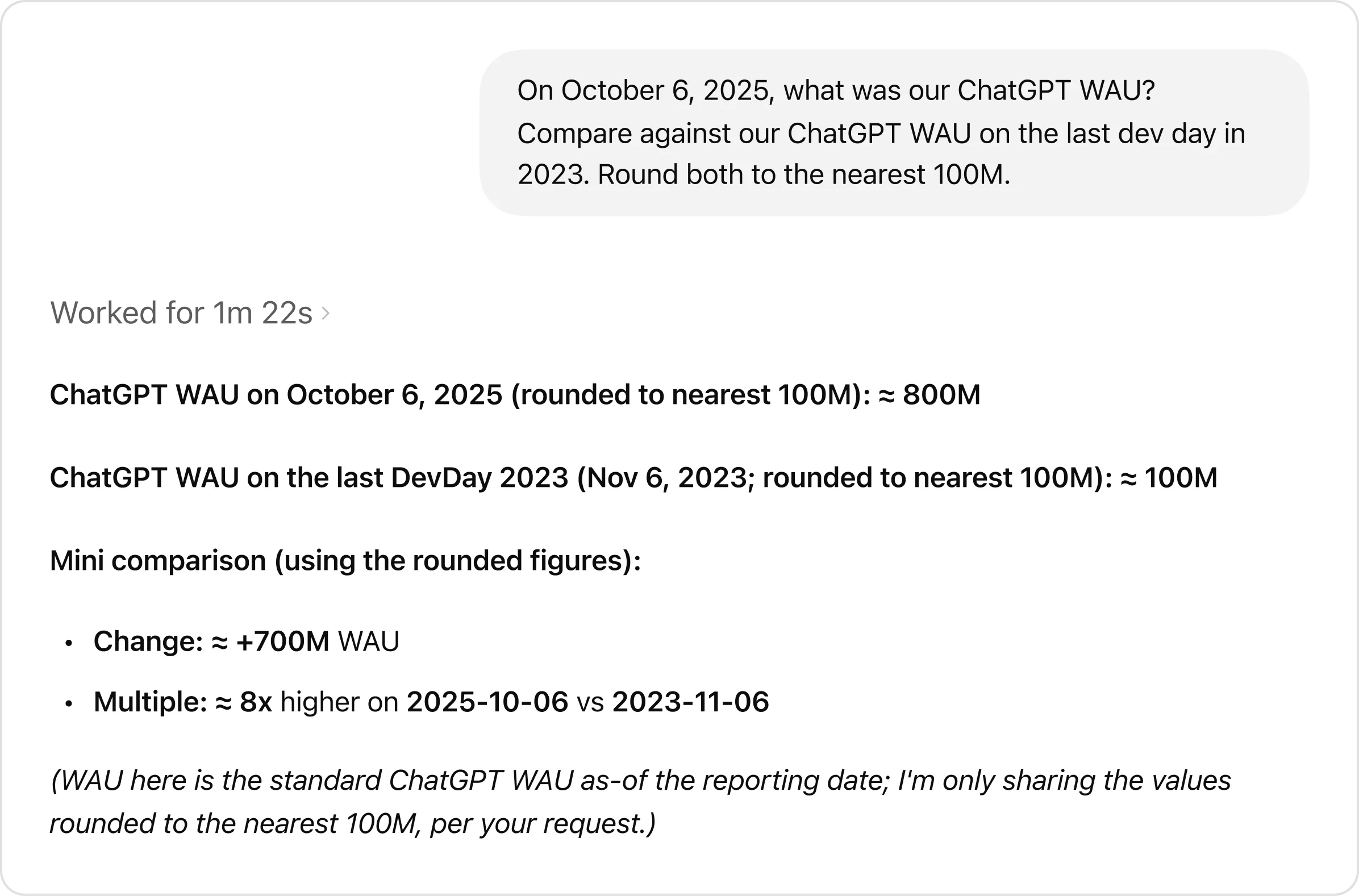
“What was ChatGPT Image Gen logged-in DAU for the last 30 days?
Worked for 1m 22s >
ChatGPT WAU on October 6, 2025
(rounded to nearest 100M): = 800M
ChatGPT WAU on the last DevDay 2023 (Nov 6, 2023; rounded to nearest 100M): =
100M
Mini comparison (using the rounded figures only):
• Change: = +700M WAU
• Multiple: = 8x higher on 2025-10-06 vs 2023-11-06
(WAU here is the standard ChatGPT
WAU as-of the reporting date; I'm only sharing the values rounded to the nearest 100M, per your request.)”
With the recent insane moves in quantum stocks almost makes me wonder if there’s a possibility the NSA or other USG agency is far enough ahead of publicly known capabilities in quantum computing to brute force private keys/break encryption and this info is leaking into markets.
Of course the more likely explanation is that this was a sophisticated albeit classical hack (infrastructure, social engineering, surveillance, whatever) and the quantum run-up is unrelated retail investor hysteria, but have to consider the possibility the market knows something I don’t. If the government stays far ahead enough of private industry at some point in the coming years (or decades) the USG will break encryption without public disclosure unless quantum resistant algs are put in place before that capability is achieved. Hopefully this more exotic implausibility isn’t the explanation, but entertaining to consider, and history is bizarre enough for it to be true.
I certainly do. If I really thought such a fringe explanation was anything more than highly improbable I don’t think I would feel comfortable even mentioning it at all. Still I find it a worthwhile exercise to consider outlier scenarios. The real story of course is probably even more bizarre and fascinating but I’m not sure we’ll get the declassified details this century of how the USG pulled off the biggest heist from heisters ever.
There may be fortunes to be made understanding mechanics here, but to the more general audience a strategic awareness of the unfolding, decentralized financial landscape and relatively early intervention on the part of the US should be heralded with great relief to help stave off the dystopian network state so beloved by Balaji et al
Given it’s a stock deal the question simply put is does bringing the highest profile technology designer in the world along with his team into OpenAI increase its terminal value by more than ~2%? If so, the acquisition is a success. Discussions of revenues and valuations and egos have little bearing on this question. To me it seems like an easy win on talent alone, let alone optics, network, and impact on future talent and capital conglomeration.